Your Guide to Food Transport Accreditation
Use this guide to food transport accreditation to check food safety systems, temperature control, records, driver training and carrier checks in Australia.
A missed temperature check, an unclean trailer or a driver without the right records can put an entire food load at risk. This guide to food transport accreditation explains what suppliers, distributors and freight buyers should look for before food leaves the warehouse – and what transport operators need to demonstrate every day.
For chilled, frozen and high-risk food, accreditation is not just paperwork. It is evidence that the carrier has practical controls in place to protect product safety, quality and traceability from collection through to delivery.
What food transport accreditation means
Food transport accreditation refers to the approval, certification or documented compliance arrangements that show a transport business can handle food safely. In Australia, the exact requirements depend on the product being carried, the state or territory, the customer’s food safety program and the role of the transport operator in the supply chain.
Some businesses may need approval under a state-based food safety scheme. Others may be assessed against a recognised food safety standard or a customer’s supplier requirements. Meat, poultry, dairy and frozen products can carry additional obligations because temperature control, hygiene and traceability are central to product integrity.
Accreditation is often used as a general term, but it is useful to separate three related areas. A licence or regulatory approval may be legally required for certain activities or food categories. Certification is generally an independent assessment against a standard or food safety system. Customer approval is a commercial requirement set by a manufacturer, retailer or distributor.
A capable carrier should be clear about which approvals apply to its operation, rather than making broad claims that do not match the freight being moved.
Why food transport accreditation matters to your business
A food safety issue in transit does not stay with the carrier. It can become a rejected delivery, a production delay, a disposal cost, a customer complaint or a reputational problem for the supplier whose name is on the product.
Accredited food transport arrangements reduce that exposure by making critical controls visible and repeatable. These controls include trailer cleanliness, temperature settings, calibrated monitoring equipment, load segregation, staff training and documented corrective action when something goes wrong.
For operations managers, the commercial benefit is straightforward. A transport provider with proven food handling processes is less likely to create avoidable delays at receival, disputes over product condition or gaps in your audit trail. It also gives procurement teams a clearer basis for comparing freight providers beyond the quoted rate.
That does not mean the highest level of certification is necessary for every load. Dry packaged goods and frozen poultry do not present the same handling risks. The right level of assurance depends on the food type, its packaging, required storage conditions, delivery destination and your customer agreements.
The controls an accredited carrier should have
Accreditation only has value when it is supported by consistent operating practices. When reviewing a carrier, ask how food safety is managed at the vehicle, driver and documentation level.
Temperature control and monitoring
For refrigerated freight, the vehicle must be capable of holding the specified temperature range for the full journey, including collections, multi-drop work, waiting time and deliveries outside standard hours. The set point alone is not enough. You need evidence of the actual conditions maintained during transport.
Ask whethertemperatures are monitoredand recorded, how often equipment is checked, and what happens if a reading is outside the agreed range. A reliable operator should have a clear escalation process, not a vague promise to “keep an eye on it”.
Temperature requirements should be confirmed before collection. A chilled product, a frozen product and an ambient dry line may require separate compartments, separate runs or specific loading arrangements. Loading a vehicle correctly is part of temperature control, particularly where a door is opened repeatedly during a multi-drop route.
Cleaning, hygiene and load separation
Food vehicles must be clean, maintained and suitable for the product being loaded. That includes walls, floors, doors, refrigeration units and any equipment used to move freight.Cleaning schedulesshould be documented, with additional cleaning where the previous load creates a contamination risk.
Load separation matters as much as cleaning. Food should be protected from chemicals, damaged packaging, leaking cartons, strong odours and incompatible products. Where different food categories travel together, the carrier should be able to explain how cross-contamination risks are assessed and controlled.
For meat, poultry and dairy freight, the required standards can be more demanding. Do not assume that a general freight operator has the equipment or processes needed for sensitive food products simply because it has a refrigerated truck.
Traceability and transport records
If a quality issue is identified after dispatch, you need to know what was collected, when it was loaded, which vehicle carried it, where it travelled and who received it. Accurate consignment records support traceability and help isolate a problem quickly.
Useful records commonly include collection and delivery times, product details, temperature logs where required, cleaning checks, maintenance records and incident reports. Electronic records can make retrieval faster, but the key test is whether the information is complete, accurate and available when an audit or investigation requires it.
Trained drivers and fit-for-purpose equipment
Drivers are a critical part of food safety performance. They need to understand loading requirements, temperature expectations, hygiene rules, paperwork and escalation procedures. They should know when to stop and report an issue, such as damaged pallets, a temperature alarm or a trailer that is not clean enough for the next load.
Equipment also needs to match the work.Tailgate-equipped truckscan support safer handling where sites do not have loading docks. Refrigerated vehicles need planned servicing, while temperature devices require regular verification or calibration. A provider should be able to show that these controls are maintained, rather than relying on an inspection completed years ago.
How to assess food transport accreditation before booking
Start by defining your own freight requirements. Be specific about the product type, target temperature, packaging, pallet configuration, collection and delivery windows, and whether the load will be delivered directly or handled through multiple drops. Clear instructions allow a carrier to confirm whether its accreditation and equipment are suitable.
Then ask for evidence that matches the risk. This may include current certificates or approvals, food safety procedures, sample temperature records, cleaning documentation, insurance details and driver training arrangements. For higher-risk products, ask how non-conformances are handled and how quickly you will be notified if a problem occurs.
It is also worth checking the practical side of the service. A compliant operator that cannot meet your delivery window may still create product risk. Confirm vehicle availability, after-hours capability, booking cut-offs, tailgate requirements and the process for urgent or weekend freight.
Price should be transparent, but it should not be considered in isolation. A low rate can become expensive if it excludes waiting time, additional drops, temperature monitoring, specialised equipment or a service level your customer expects. A detailed quote gives you a more realistic view of the total transport cost.
A practical accreditation checklist for transport operators
For transport businesses building or reviewing their food safety arrangements, the focus should be on controls that staff can follow under real operating conditions. The system needs to work during early starts, delayed collections, overnight runs and last-minute schedule changes.
A practical program should cover at least these areas:
- documented food safety procedures for the freight you carry;
- vehicle cleaning, inspection and maintenance schedules;
- temperature monitoring, verification and corrective action;
- staff induction and refresher training;
- load segregation and damaged-product procedures;
- traceable transport records and complaint handling; and
- regular internal checks to identify gaps before a customer or auditor finds them.
Keep procedures clear and relevant to the driver’s job. A large manual does not protect food if the driver cannot quickly find the correct action when a refrigeration alarm sounds or a consignee rejects a pallet.
Questions to ask your refrigerated freight provider
Before appointing a carrier, ask whether it holds the relevant food transport approvals for your product and service area. Ask how temperature is monitored, how long records are retained, and whether readings can be supplied if a customer queries a delivery.
You should also ask what checks occur before loading, how trailers are cleaned between loads, whether drivers are trained in food handling requirements, and who contacts you if there is a delay or temperature deviation. The answers should be specific, operational and easy to verify.
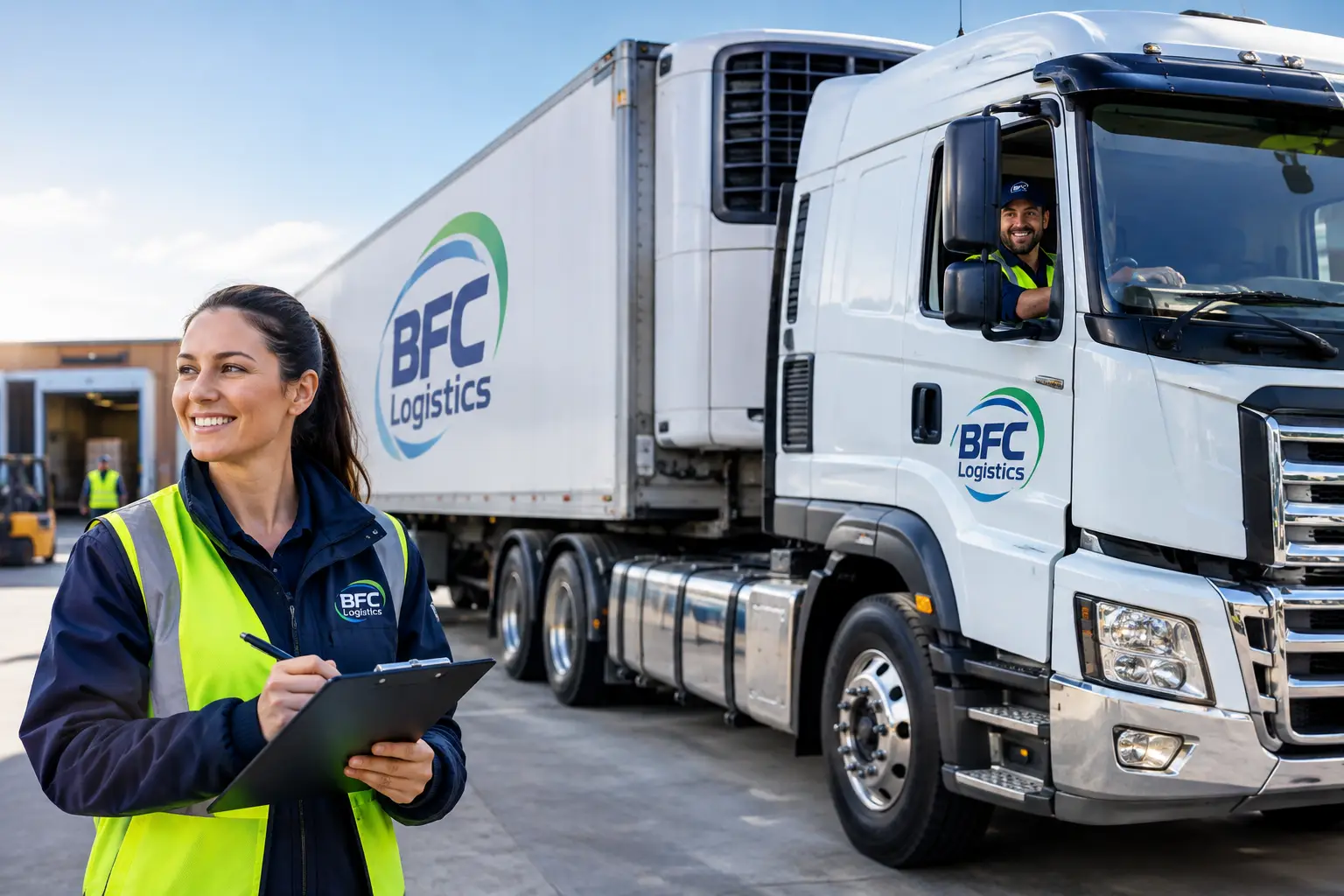
For businesses moving food across Brisbane and South East Queensland, BFC Logistics provides temperature-controlled freight supported by SAFE FOOD accreditation, monitored equipment and trained drivers. The service is designed for businesses that need reliable handling of chilled, frozen, cold and dry food freight within strict delivery windows.
The best transport partner will treat accreditation as part of daily delivery performance, not a certificate kept in a folder. When the controls, records and communication are in place, your food arrives with the confidence your customers expect.
NEED TEMPERATURE-CONTROLLED TRANSPORT?
Talk to BFC about your freight, delivery window and temperature requirements.
Request a quote